
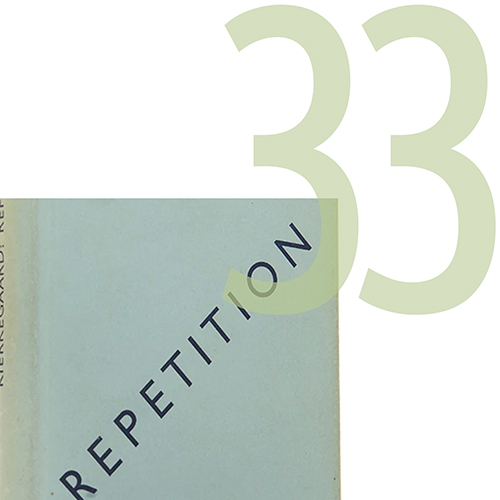
“Recollection is a discarded garment that does not fit, however beautiful it is, for one has outgrown it. Repetition is an indestructible garment that fits closely and tenderly, neither binds nor sags.” – C.C. 1843.
1993. Those were dark times. I wanted to get away somewhere.
I don’t remember how I found the address of a printmaking residency in Finland—and it doesn’t really matter. If only that were the only thing I couldn’t recall! But once I received confirmation from the residency that I was welcome, I packed two incredibly heavy suitcases and set off. I had no money, didn’t speak the language, and had no idea where I was actually heading.
The strangest thing is that, just before I left, a Lithuanian living in the very city I was traveling to got in touch and asked me to bring along a few bottles of champagne. Christmas and New Year were approaching…
In those bleak times, there were no mobile phones or navigation systems; you had to rely solely on your own wits and a paper map—though even those were hard to come by, as hardly anyone from Lithuania travelled abroad. Unless, of course, you count the car dealers who used to travel to Germany.
I remember leaving home and heading toward the bus stop. I would carry one suitcase, set it down, then go back, grab the second one, and carry it up to the first. That is how I travelled. And what was inside those heavy suitcases? Zinc plates for etching, paper for printing, food for a month—since I had to survive somehow—and two bottles of cheap Lithuanian champagne.
I don’t recall exactly how I ended up in Tallinn—by bus, I suppose. I also don’t remember how I figured out where the ferry to Helsinki was. All I remember is that, once in Helsinki, at a bus stop—without knowing the language—I somehow managed to ask how to find a train (why not a bus?) to Jyväskylä.
Kind people explained everything, and I boarded a bus—lugging my heavy suitcases along—that took me to the train station. Finally, my destination felt within reach.
The train station was packed with people in high spirits. I had absolutely no idea what was going on—were they all heading to the same place as me? Why were they so cheerful, and a little tipsy, too? To be honest, I didn’t even care where the train was actually going anymore; I was just too exhausted from such a crazy journey.
I remember finding an empty seat and sitting down. The train carriage soon filled up with passengers carrying musical instruments and various banners or signs. A cheerful, older Finnish man sat his stout female companion—a wife or girlfriend, perhaps—on my lap and said, “She’ll just sit here…” Could I have objected? Maybe, if I’d known how. But my inability to speak the language spared me from any conflict, so that’s how we travelled. Someone played an accordion, others sang, everyone was shouting—it was a lively scene.
The train made stops, cheerful passengers got off, and at one point—by now quite dark outside—I noticed that my train carriage was almost empty; only two young men were sitting a few rows ahead, observing me intently.
Eventually, one of them sat down next to me and asked something. Naturally, I didn’t understand what he was asking. But somehow, I managed to convey the only thing that mattered to me: that I was heading to Jyväskylä—perhaps I showed him a slip of paper with the address; I don’t quite recall… He replied, “Yes, yes, the train is going to Jyväskylä.” I then asked, “Well, where should I get off?” A rather timely question, considering I was heading into the unknown. From what the young man said, I gathered that this would be the train’s final stop—which was at least a relief; at least I wouldn’t have overshot my destination.
They also mentioned that the workshop I was headed to wouldn’t be open at night. We got off the train. The two young men—well, they were younger than me, as I was only 29 at the time—asked what I planned to do all by myself in an unfamiliar city, in the middle of the night, in the dead of winter. A fair question. I had no answer. For some reason, they suggested, “Well, if you don’t have a plan, why don’t you come with us to a bar?” Did I really have a choice?…
They were trying to be friendly and help out, so one of them attempted to lift a suitcase. It weighed about 40 kg. They were quite taken aback, so the two of them ended up carrying it together—taking breaks along the way—through the town park and past the church, heading toward the night bar.
Eventually, we reached the place. It was packed with cheerful young people; there was loud music and shouting—just like a “real” bar, the kind I’d never actually been to before… They immediately sat me down at a table against the wall on the left and explained: “Since you don’t have any money”—which was pretty obvious just by looking at me—”you’ll be drinking tea here—it’s free—while we go have a drink and enjoy ourselves.”
I drank my tea and wondered how it would all end. But, at deep night, all bars close eventually all bars close eventually; the young men approached me and said, “Alright, we’re going to our place now—we’ll take a taxi, so let’s all chip in for the fare.” This scared me a little—who were they? Why were they taking me along? Could they have bad intentions toward me…? But the taxi arrived, and we headed off—if I recall correctly— toward a new part of the city, where there are apartment blocks, heading to their flat.
They put me up in a separate room, and I passed out immediately. In the morning, they made breakfast and said, “Well, it’s time to call your boss and let them know you’re here, so they can come and pick you up.”
Jukka Partanen, the director of the printmaking workshop, arrived looking very surprised; he gathered up my suitcases and took me—in his Subaru—to my first international printmaking workshop.
I never met those young people again. To be honest, I’m not even sure if they exist at all.

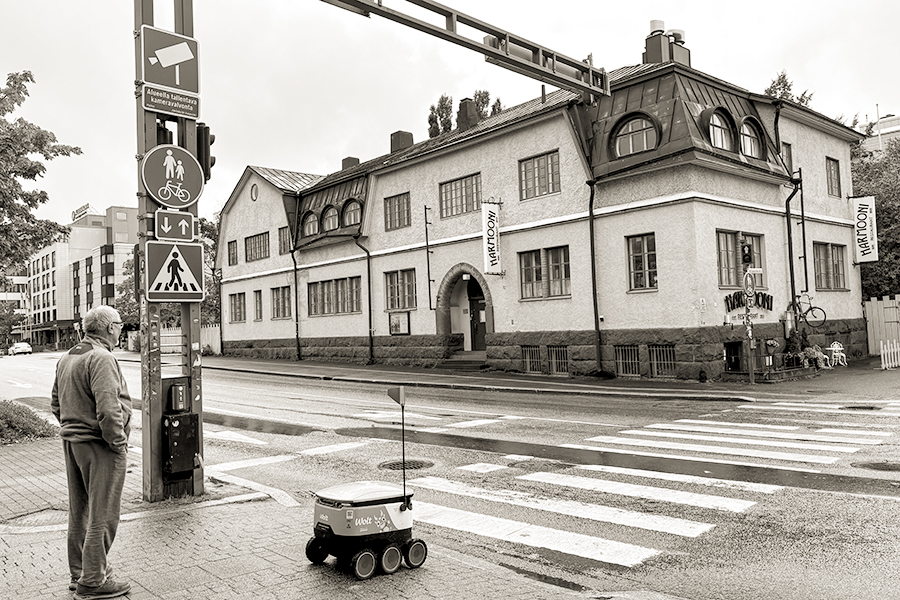
33 years have passed.
I received an invitation to participate in a printmaking symposium in Karelia, southern Finland, and to share my experiences with art residencies with other artists. Since I have a little interest in printmaking—having worked in 30 print and art studios across Finland, Sweden, Germany, Switzerland, Italy, Belgium, the Netherlands, China, and elsewhere—I decided to go.
Upon arriving in Lappeenranta for the international printmaking symposium—this time by car rather than by train, with enough command of the language to communicate, and no longer as destitute as I once was—I decided to visit the man who had believed in me, supported me, and encouraged me in every way: Jukka Partanen. Having my own car, the drive to Jyväskylä to visit Jukka—along beautiful forest roads—was no trouble at all.
I visited Jukka and Raija at their lovely country home near Jyvaskyla, a place I had been to once before. After a conversation about art and life, Jukka and I visited the old Printmaking studios. However, this old building—where artists from various countries created for many years—now houses a hotel and a restaurant… Only the license plate from Jukka’s car—the same Subaru in which he brought me to the Residency with two heavy suitcases—remains attached to a wall in the hotel courtyard, serving as a reminder of the days when the director’s white car used to be parked here.
In the evening, Jukka and I arrived at the apartment of the Printmaking Residence where I was to spend the night. As we walked from the car toward the building, we passed a strange café—or perhaps a bar—and Jukka remarked, “This is a weird little bar for young people.”
We arrived at the apartment of the Printmaking Residence where I was to spend the night. As we walked from the car toward the building, we passed a strange café—or perhaps a bar—and Jukka remarked, “This is a weird little bar for young people.” After dropping my small backpack in the room, we headed back to Jukka and Raija’s place for a lunch.
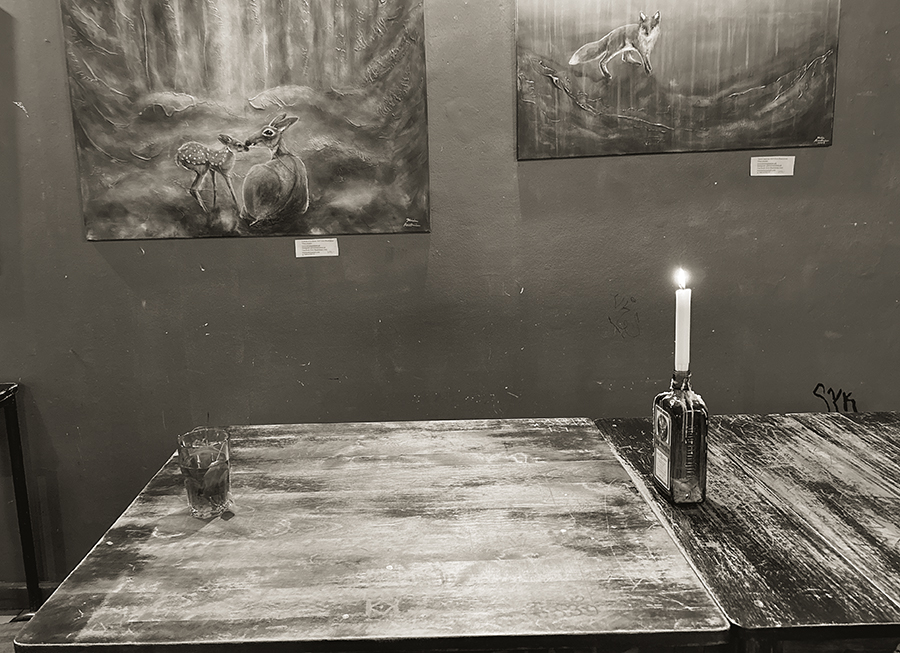
In the evening, I returned to my apartment. I then headed down the stairs to the street and walked about 25 meters to that strange bar Jukka had mentioned. I went inside. A few men sat alone, drinking beer; music played softly. They looked up, taking me in—a strange figure in a raincoat and hat—before sinking back into their own thoughts. I looked around. There were odd paintings on the colourful walls and sculptures resting on a wide windowsill; everything was decorated in such a peculiar way—I loved it. The place felt familiar. Tables lined the wall on the left, stairs led upward, and on the right stood a bar where a bored-looking bartender was stationed. I walked over. “What can I get you?” she asked. “Oh, nothing—I just wandered in. I think I was here 33 years ago.” “Hmm, that was quite a while ago,” the bartender replied. “So, what will you have?” “I was here back when I didn’t have a single penny to my name, and I drank tea for free—over there, on the left, by the wall. I’ll have some tea again,” I said.
I took my tea and sat down at a table on the left. The barmaid came over, lit a candle on the table, and returned to the bar. Music played softly. Someone entered the bar, walked noisily toward the communal restroom, and then left just as loudly. Music played softly. I sat and drank my tea, just as I had 33 years ago—without hope, and without despair.
Then I got up, walked slowly to the bar, and asked, “How much?” “For free,” the barmaid replied—just as she had 33 years ago, “Nothing”.
“I’m an artist,” I said. “Great! Maybe you’d like to hold an exhibition of your work here at the bar—once the current exhibition ends?” she asked. “Maybe.” And I stepped out into the darkness.
2Cent.
The text was created using Google Translate.
© Artist’s Book Museum 2026